
Resources
Learning Disabilities: What Educators Need to Know
This document provides an overview of learning disabilities and explains various ways educators can help support students who experience learning challenges. The document covers how to recognize LD’s, understand the effect on students and how and when to use appropriate teaching strategies and accommodations. I believe this information is valuable for my future career because as a teacher because I will work with students and families who may not be diagnosed with an LD but are demonstrating signs of LD’s . Understanding LD’s will help me adapt my teaching methods, give appropriate support and create a classroom where each student can shine in. For example if I notice a student struggling to keep up with written assignments and having difficulty comprehending written instructions, I could provide verbal explanations to them a break the assignment criteria into smaller steps. This would ensure the student can demonstrate their understanding without being held back by their LD’s.
Foothills Academy Society. Learning Disabilities: What Educators Need to Know. https://www.foothillsacademy.org/content/download/Learning_Disabilities_What_Educators_Should_Know_Feb._2019B.pdf
Classroom Strategies for the LD Child
This article provides strategies teachers can use to support students with learning disabilities. It discusses different learning challenges students may face in the classroom such a difficulties with attention, reading, writing, math, organization, memory and social skills. This article emphasizes the importance of adapting teaching methods to meet the individual students needs. Some suggested strategies include breaking assignments into smaller parts, giving visual and written instruction, allowing extra time, using checklists to improve organizational skills and giving students encouragement to build self esteem with learning. As a future teacher I can look back on this article for specific strategies to help improve any students I have with LD’s learning experience.
Admin. Classroom Strategies for the LD child. Learning Disabilities Association of PEI. https://ldapei.ca/classroom-strategies-for-the-ld-child/
Inclusive Education Resources
This resource provides educators with information, policies and tools for supporting students with learning disabilities and diverse learning needs. It includes information about Individual Education plans, inclusive class work for students with wide varieties of LD’s. This provincial resource is updated regularly with current information ensuring that I can always utilize it in my future classrooms.
Ministry of Education and Child Care. (2026, September 21). Inclusive Education Resources. Province of British Columbia. https://www2.gov.bc.ca/gov/content/education-training/k-12/teach/resources-for-teachers/inclusive-education/
Videos
Communicating with People with Learning Disabilities
This video discusses challenges individual with communication disabilities may face when understanding information, processing language and expressing themselves. The video explains that communication abilities can often be misunderstood, as teachers often assume a student has less understanding than they actually do based on how they can communicate. The video highlights strategies to improve communication with these students. Such as using simple and clear language, allowing students extra time so they can process information, limit background noises, use visual aids and various forms of communication, these could be pictures, technology or even sign language. This resource will be valuable when I become a teacher because I will work with students who process information and communicate in different ways. I think it is important to recognize that not all students will process information using the same forms of communication. This video shows me examples of different ways I can communicate with students so all students can have their learning needs met in my classroom.
Supporting Students with Dysgraphia
This Youtube video explains dysgraphia which is a learning disability that affects a person’s ability to write, spell and organize their thoughts on paper. The video discusses the common signs of dysgraphia which includes trouble holding a pencil, slow writing, inconsistent letter sizes and spacing between words and poor spelling. This video shows that students with dysgraphia usually have strong thinking abilities but struggle transferring it onto paper. The video also gives viewers strategies to aid students with dysgraphia in the classroom. These strategies are giving the student a pencil grip, allowing extra time, using speech to text technology and offering alternate ways to complete assignments such as oral presentation.
Eye to Eye: Learning Disabilities Become Strengths
This video talks about a program at Temple University called Eye to Eye. At this program students with learning disabilities are partnered with a mentor who has the same learning disability as them. Together they can navigate challenges that they may face. This video emphasizes that learning disabilities should be viewed as strengths and not weaknesses and students with learning disabilities should not be held back by their abilities but supported so they can be their best. In my future career as a teacher, I never want to make a student feel limited in the classroom because of their ability. I want to use what I have learned in this class to best equip my students for success whether that’s adapting an assignment so they can comprehend more clearly or communicating with their support system so I can see how to best aid them.
Strategies
Cognitive Credit Cards (CCC)
A cognitive Credit Card helps students improve their metacognitive ability to learn, as well as problem solve. On a card, the teacher can write prompts that will help a student organize their studies. To develop a CCC a teacher starts by recognizing that a student does not use a particular learning strategy. The textbook used the example of Karl, Karl is struggling with adding and subtracting and says there were “just too many things to keep in my head at the same time”. His teacher recognizes a lack of metacognitive ability and created a CCC specific to his task. The CCC guides Karl through the equation and allows him to visually see the steps and prevent steps from getting “lost” on the way. Seeing how a CCC aided Karl I would love to implement it in my future classroom when I have students who struggle with step by step work. I think of my time in math as I got older and struggled when equations got more complicated, a CCC could have helped guide me through achieving the task I was working on without needing to have a teacher help me with each step. (p.116-117)
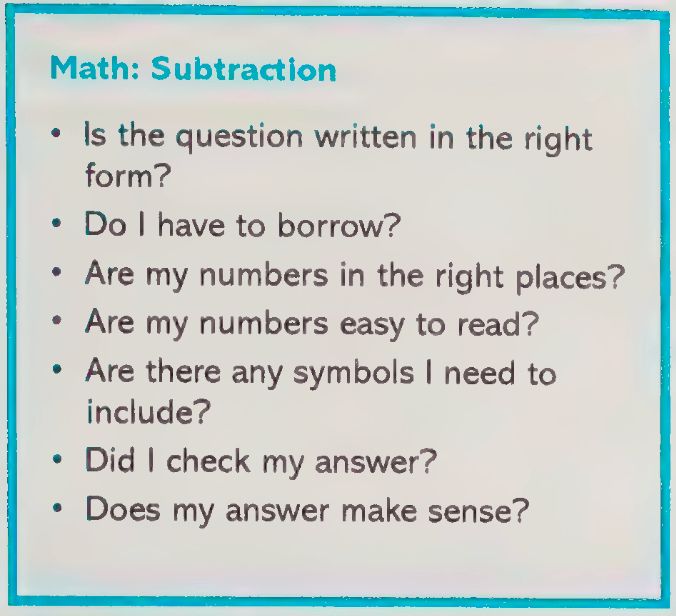
Karl’s CCC for Subtraction
Edmunds,A.L., & Edmunds,G. (2014). Special education in Canada: Second Edition. Oxford University Press.
Chunking
This article explains how “chunking” helps students remember information by breaking it into smaller groups. Our working memory has limited space, meaning we can only process a certain, smaller amount of information at once. Chunking helps by grouping individual pieces of information together so the brain has fewer things to remember. An example of chunking is used when we try to remember phone numbers. Instead of trying to remember 10 digits consecutively we break it up into groups of 3 or 4 to make it easier for our brains to remember. Chunking is a common strategy for teachers teaching students with ADHD or dyslexia. Instead of overwhelming a student with a plethora of instructions about an assignment instead you can chunk them into two or three instructions at a time allowing the student to focus on a smaller amount of tasks at once.
Belsky, G. (n.d.). Can chunking improve memory?. Understood. https://www.understood.org/en/articles/chunking-memory-strategies
Multi-sensory activities for Students with Dyslexia
Multi-sensory activities use more than one of the five senses to help students understand and remember information. Students with dyslexia benefit from multi-sensory activities because they can connect reading and spelling to different experiences rather than relying on only reading and writing.
Mulit-sensory activities include
- Writing Letters in Sand
- Using magnetic or wooden letters to build words
- Picture and Word Matching
- Colour Coded Reading
- Playdough Letters
These activities give students a different way to understand and process information as well as reinforce connections between letters, sounds and words. I want to use Multi-sensory activities in my future classroom so all students can learn and demonstrate their understanding. Instead of having students traditionally write and read words and having them potentially relying on their memory using these activities can affirm that they are making connections between letters and sounds.
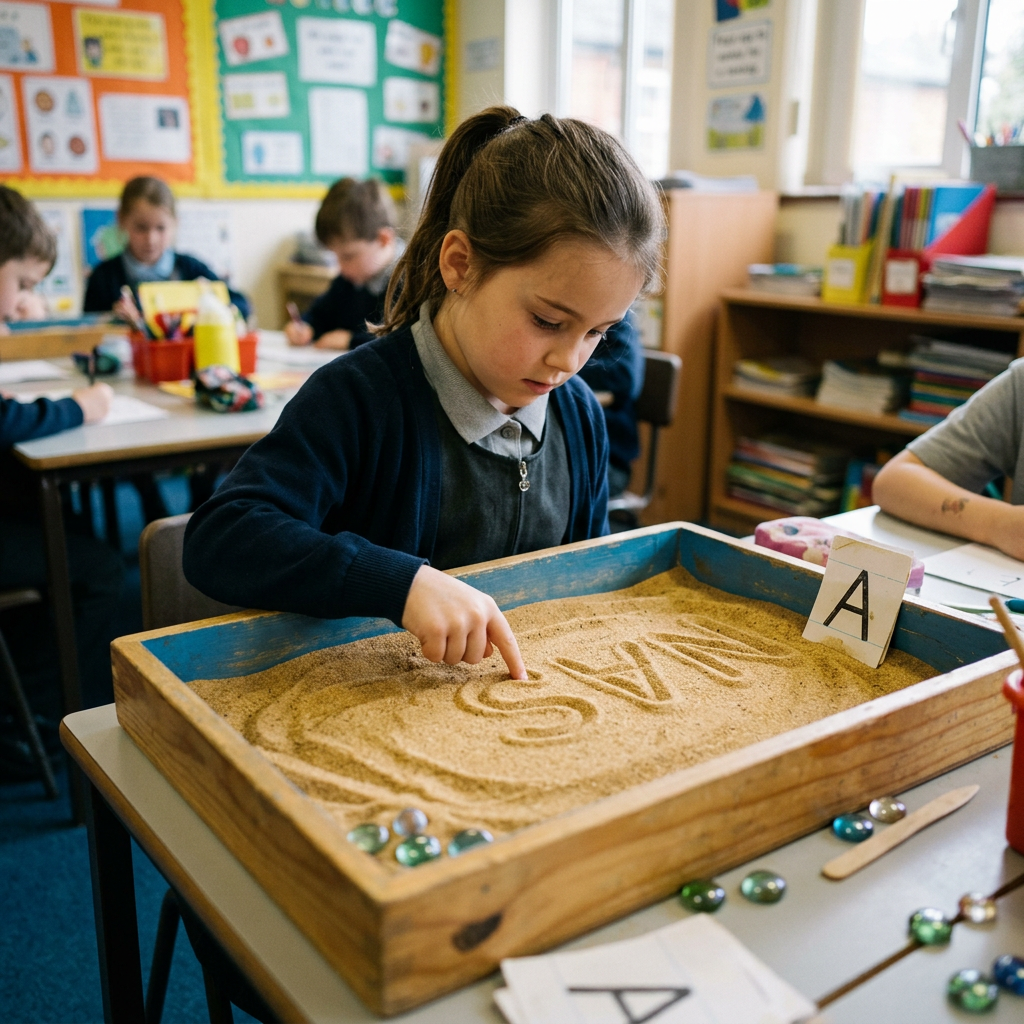
Teaching strategies for students with dyslexia | School of Education | American University, Washington, DC. Teaching Strategies for Students with Dyslexia. (n.d.). https://www.american.edu/baker/graduate/articles/teaching-strategies-for-students-with-dyslexia.cfm


Leave a Reply